
We recently held a tailgate at the office to open football season, and everyone wore their favorite team’s swag. My team knows that I am a lifelong Penn State, Villanova, and Eagles fan, but on this day I wore a Georgia Bulldogs shirt to honor my new home. When I walked in, our team stood alongside several customers that we also count as teammates. Together, they cheered Source Support three times and my heart swelled with pride for our team.
What they did not see was the decision I had made in the parking lot a few minutes earlier. Before arriving, I had run to Publix for party snacks and loaded the bags into my truck. Standing at the tailgate, I was faced with the choice everybody has when there is too much to carry. Two trips. All of it at once. Or one bag at a time.
I did none of those, because I had also stopped at Target first and bought a popup wagon. The bags went in the wagon, and I used the wagon to cross the lot which freed my hand up to wave at our people and our customers on the way in. In that moment, I walked across the lot relaxed instead of winded.
Most organizations think brand protection begins with marketing. I believe it begins with execution. Every service visit, every dispatch, every compliance check, and every customer interaction teaches your customer what your brand is worth. Orchestration is what makes sure that lesson is a good one.
The wagon did not make the snacks lighter. It moved the load onto something built to carry it, allowing me to comfortably multitask upon arrival.
The same thing happens every day in field service. We often celebrate the technician who solves the problem, but we rarely see everything that must happen before that technician ever arrives on site. Scheduling, certifications, compliance requirements, parts availability, customer communication, documentation, status tracking, and escalation management all compete for the same limited time and attention. When those responsibilities are carried manually, even highly skilled professionals spend energy on work surrounding the service instead of the service itself.
Our vision at Source Support Services is to orchestrate the world of work at scale, and that vision starts with an honest look at how work actually happens. It is distributed across sites, countries, and companies. It is specialized enough that no single person holds the whole picture. It is too complex to rest on individual effort, no matter how talented the individual.
A technician may seem to stand alone in the moment of service: one person, one site, one problem to solve. But that picture is incomplete. Great outcomes depend on a continuously running network of people, technology, processes, visibility, expertise, flexibility, and accountability. Orchestration brings that network together, so the customer experiences one coordinated teammate instead of a collection of separate parts.
The technician still does the work; the same way I still crossed the lot. What changes is everything they no longer have to carry by hand.
When execution gets harder, most organizations respond by adding. More people. More vendors. More spreadsheets. More status meetings. None of that removes complexity. It simply gets redistributed, usually onto the people closest to the customer. Eventually, someone drops a bag.
Look closely at where the hours go and you will find a dispatcher chasing a certification record and an engineer making three calls to learn whether a part shipped. Those are good people working hard at necessary tasks, but it represents the equivalent of two trips across the lot. It is not what I would call efficient orchestration. It is what an organization is forced to do when orchestration is missing.
At ten service events, a fragmented model looks fine. At ten thousand, across dozens of countries, it produces variation, and variation is what your customer experiences as an unreliable brand.
Our Unified Services Platform is the orchestration engine we built to turn complexity into consistent outcomes. Credentials are validated against the job. Skills are matched to the equipment. Parts are tracked to the site. Milestones are monitored, and when a case is leaning towards a potential quality event the system raises the exception rather than waiting for someone to notice.
Our customers already have a service promise to keep. Our job is to help them deliver it consistently, in every market they serve, and within every service event we touch.
As we evolve our platform leveraging AI and automation at Source Support will not be about replacing people. It will be about carrying more of the operational load through technology so people can focus on solving problems. We want the technology to make problem solving easier, with quality that is documented, measurable, and consistent.
Free hands are the point. The engineer who calls our Source Operations Center late at night is not looking for a status update. They are looking for a person, and our people have room for that because the platform balances the case load thereby lowering the stress in the field. That is how a network becomes a relationship.
Lower stress is not a soft benefit. Safety and compliance are the issues that stop a company cold when they are handled badly, and the risk multiplies across locations. Taking a disciplined approach mitigates the risk of fines and work stoppages and allows for consistent service outcomes across our customers’ portfolio of offerings and in support of their service promise to the markets they serve.
Every employee at Source Support is a teammate, and we use that word deliberately. A teammate is not simply a colleague at work. A teammate is someone who shares accountability for the same service outcomes that matter to our valued customers. Our people look out for our brand and our customers’ brand every day and protecting them is not separate from protecting that brand. Caring for our employees is how we care for our customers, and we built that into the orchestration.
One technician at the moment of service. A full network behind them, orchestrated into one coordinated teammate for the customer.

The network behind one technician. Always running, so nobody arrives at a customer site alone.
For the OEMs and data center operators we serve, every service event is a brand event. Your customer may never meet your engineers or your executives. They will meet the person who shows up when something breaks, and how that person arrives is what they remember.
Fragmented models put your promise at risk quietly. A missed credential. A second trip that should have been a first-time fix. Together they teach your customer what your brand is worth. That is the difference between labor fulfillment and service orchestration. A labor provider fills a slot. Orchestration protects the brand that walks through the door.
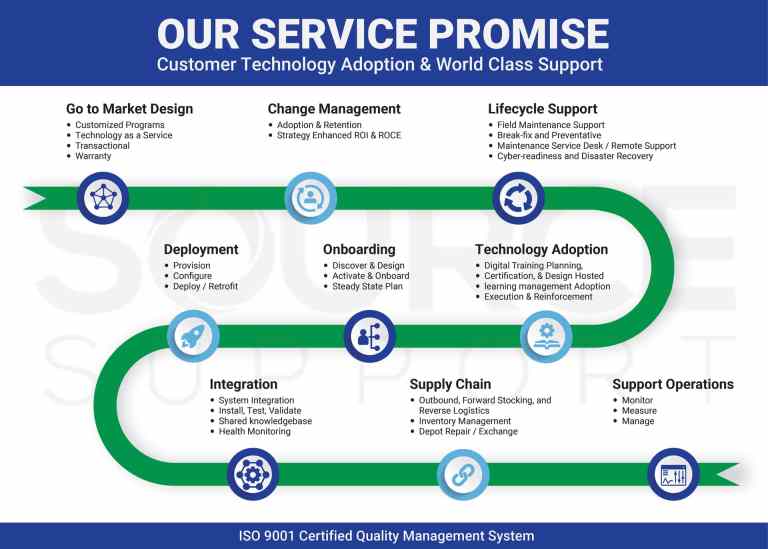
Our dedicated team, paired with the Unified Services Platform, is how we deliver a service promise that is consistent, reliable, scalable, compliant, and protective of your brand.
So here is the question worth asking about your own operation. How much of your brand still depends on people carrying work that a properly orchestrated system should carry for them? The answer tells you how much of your customers’ service promise is depending on individual effort instead of orchestrated readiness.
I still think about that walk across the lot, and the sound of our team and our customers cheering on the other side of it. My job is to use every resource available to make their work easier. Where expertise meets orchestration, the technician never stands alone, and the customer gets one coordinated teammate.
Customers do not buy effort. They buy outcomes. Orchestration is how those outcomes get delivered consistently, at scale, every time.
Visit sourcesupport.com or reach out to sales@sourcesupport.com.

CEO, Source Support Services
Jim Kirby is Chief Executive Officer of Source Support Services, a global technology services company headquartered in Lawrenceville, Georgia, serving customers in more than 120 countries. With 39 years of experience across technology, services, and enterprise software, Jim has built and scaled businesses, launched global service portfolios, and led go to market strategies across OEM, managed services, and digital transformation.
sourcesupport.com | Connect with Jim Kirby on LinkedIn
