
I never served. I want to say that plainly before anything else about Veterans Day, because the day belongs to the people who did, and I am not going to borrow a uniform I never wore.
What I can speak to is the view from where I sit: I lead a company made stronger by people who served and now work alongside us. On November 11, I want to thank both those who wear the uniform today and those who have served our country over the years.
I also want to address what too often happens after November 11: when the fanfare is over and the posts come down, but the harder question remains. To my fellow leaders, I ask: What are we actually offering the people we just thanked?

The headline figures suggest this problem is solved. The Bureau of Labor Statistics counted 17.3 million veterans in 2025, with veteran unemployment at 3.5 percent, up from 3.0 percent a year earlier.1 By that measure, veterans are working.
Look one layer down and a different picture shows up. A 2024 study of post-9/11 veterans in the Journal of Veterans Studies found that roughly one third still reported being underemployed nearly three years after leaving the military, meaning their work did not match their skills, education, or experience. Those who were both underemployed and dissatisfied with their pay earned about $24,000 less than peers who reported neither.2
That is not a hiring problem. Veterans are getting hired. It is a ceiling problem.
When someone suggests that a transitioning service member look at field service or the skilled trades, plenty of people hear a step down. A job rather than a career. Something to do until something better comes along.
I understand why. Our industry has rarely shown people what the top of this ladder looks like. So let me show you ours.
In August, Edward Krzysik joined Source Support as Vice President of Field Service, where he now leads our global field service network. Before that he founded Veterans in Field Service, a nonprofit built around four fundamentals this industry needs: hiring, mentoring, outreach, and entrepreneurship. He also teaches and holds an MBA from the American Military University.
I did not hire Edward as a gesture. I hired him because he was the right person to lead that part of our business, and the community he spent years building came with him. Last month he joined a panel at the AUSA Annual Meeting called Beyond the Uniform, on identity, purpose, and belonging after service. He put it simply: the uniform may come off, but the mission to serve never ends.
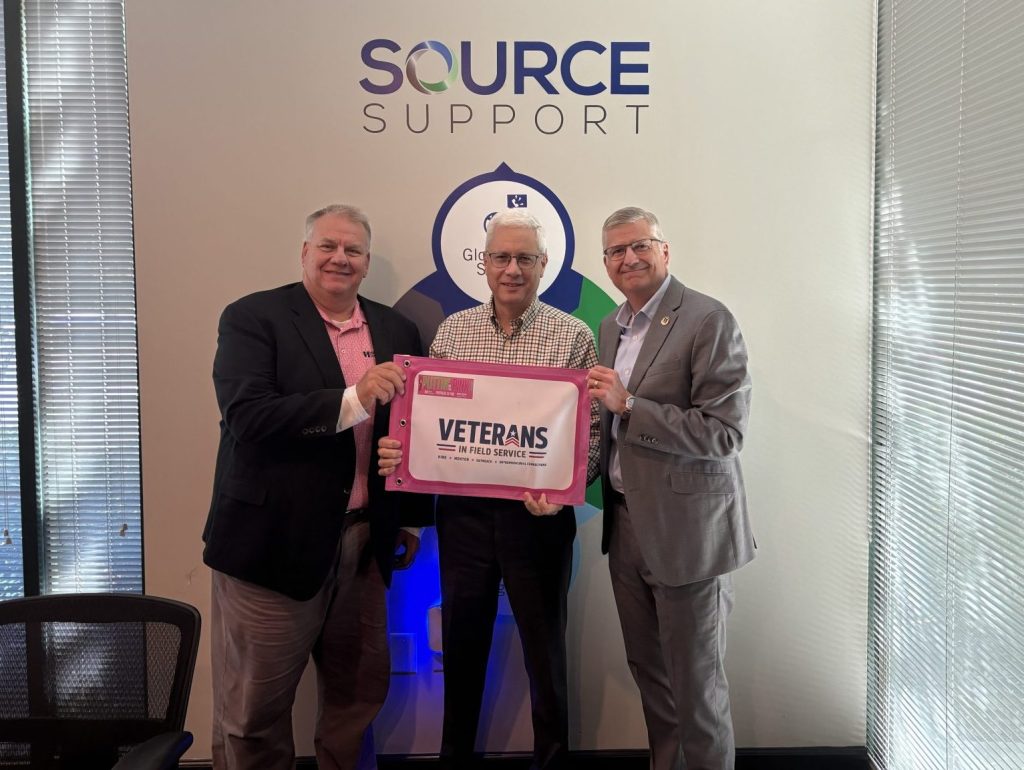
Thank you costs nothing. A credential, a first assignment, and a visible path to the top of the building cost something. That is the version worth offering.
I did not hire our Chief Operating Officer, Eric Lomascolo, but I work beside him every day. He spent more than six years in the Air Force and Air Force Reserve as an inflight refueling specialist, flying a boom to tolerances measured in inches. He now runs operations across more than 120 countries, and he has written that service is not a phase of life that ends when you take off the uniform.
Two men from different branches, who came to Source Support at different points in their careers, landed on the same idea. I pay attention when that happens.
Getting hired is the door. The ceiling decides whether anyone stays. Our Source Techworks network recruits, screens, credentials, and trains field engineers, and Source Academy keeps that training current as products change. That infrastructure exists to translate military experience rather than discount it.
Someone who maintained generators, radar systems, or aircraft has already done the hardest part. What they need is a credential our customers recognize, a defined first ninety days, and a manager who knows what their record means.
Someone will point out that a nonprofit founder and a chief operating officer are not typical outcomes. That is fair, and two people are not a statistic. But the case for the trades was never that everyone becomes a vice president. It is that the ceiling is real, the path is built rather than accidental, and the work pays well while you climb it.
If you are preparing to take off the uniform and wondering what comes next, our team would like to talk with you. Bring the record you already have and we will handle the translation.
If you lead a veteran-owned staffing firm, training organization, or trade business building the same bridge, we are expanding our partner network and there is room in it for you.
To everyone who served, on November 11 and on the other 364 days: thank you. We at Source Support Services honor and appreciate your service.
Sources

CEO, Source Support Services
Jim Kirby is Chief Executive Officer of Source Support Services, a global technology services company headquartered in Lawrenceville, Georgia, serving customers in more than 120 countries. With 39 years of experience across technology, services, and enterprise software, Jim has built and scaled businesses, launched global service portfolios, and led go-to-market strategies across OEM, managed services, and digital transformation.
sourcesupport.com | Connect with Jim Kirby on LinkedIn
